Through practising the instructions presented in this book we can transform our life from a state of misery into one of pure and everlasting happiness. These instructions are scientific methods to improve our human nature. Everybody needs to be good-natured with a good heart, because in this way we can solve our own problems as well as those of others, and we can make our human life meaningful.
Showing posts with label Religion. Show all posts
Saturday, February 11, 2017
Tuesday, July 5, 2016
The Tibetan Book of the Dead
According to Tibetan tradition, the Liberation Through Hearing During the Intermediate State was composed in the 8th century by Padmasambhava, written down by his primary student, Yeshe Tsogyal, buried in the Gampo hills in central Tibet and subsequently discovered by a Tibetan terton, Karma Lingpa, in the 14th century.
The Tibetan Book of the Dead was first published in 1927 by Oxford University Press. Dr. Walter Y. Evans-Wentz chose this title because of the parallels he found with the Egyptian Book of the Dead.
Documentary Video : https://www.youtube.com/watch?v=iEX5mBqa554
The Tibetan Book of the Dead was first published in 1927 by Oxford University Press. Dr. Walter Y. Evans-Wentz chose this title because of the parallels he found with the Egyptian Book of the Dead.
Friday, May 13, 2016
The Experience of Samadhi By Richard Shankman
Dharma practice comprises a wide range of wise instructions and skillful means. As a result, meditators may be exposed to a diversity of approaches to the core teachings and the meditative path--and that can be confusing at times. In this clear and accessible exploration, Dharma teacher and longtime meditator Richard Shankman unravels the mix of differing, sometimes conflicting, views and traditional teachings on how samadhi (concentration) is understood and taught.
In part one, Richard Shankman explores the range of teachings and views about samadhi in the Theravada Pali tradition, examines different approaches, and considers how they can inform and enrich our meditation practice.
Part two consists of a series of interviews with prominent contemporary Theravada and Vipassana (Insight) Buddhist teachers. These discussions focus on the practical experience of samadhi, bringing the theoretical to life and offering a range of applications of the different meditation techniques.
In part one, Richard Shankman explores the range of teachings and views about samadhi in the Theravada Pali tradition, examines different approaches, and considers how they can inform and enrich our meditation practice.
Part two consists of a series of interviews with prominent contemporary Theravada and Vipassana (Insight) Buddhist teachers. These discussions focus on the practical experience of samadhi, bringing the theoretical to life and offering a range of applications of the different meditation techniques.
Wednesday, May 4, 2016
The Great Secret of Mind: Special Instructions on the Nonduality of Dzogchen By Tulku Pema Ringtsal
Dzogchen (Great Perfection) goes to the heart of our experience by investigating the relationship between mind and world and uncovering the great secret of mind's luminous nature. Weaving in personal stories and everyday examples, Pema Rigtsal leads the reader to see that all phenomena are the spontaneous display of mind, a magical illusion, and yet there is something shining in the midst of experience that is naturally pure and spacious. Not recognizing this natural great perfection is the root cause of suffering and self-centered clinging. After introducing us to this liberating view, Pema Rigtsal explains how it is stabilized and sustained in effortless meditation: without modifying anything, whatever thoughts of happiness or sorrow arise simply dissolve by themselves into the spaciousness of pure presence.
The book is divided into chapters on the view, meditation as the path, conduct, the attainment, and the four bardos. Each chapter consists of mini-sections that can be read as stand-alone Dharma talks. Pema Rigtsal has studied and lived with several authentic Dzogchen masters and has surprising stories to tell about their unconventional methods to introduce students to the subtle view of Dzogchen.
Tuesday, April 5, 2016
Idealism The Philosophy Of The Matrix And The True Nature Of Matter By Harun Yahya
"What is real? How do you define "real"? If you're talking about your senses—what you feel, taste, smell, or see—then all you're talking about are electrical signals interpreted by your brain."---The Matrix Movie
This book contain conclusion, the fact that the matter is an illusion formed in our brains does not "reject" the matter, but provides us information about the real nature of the matter: that no person can have connection with its original.
Matter : The Other Name For Illusion By Harun Yahya
What is explained in this book is an important truth, which has surprised many and changed their perspectives on life. This truth can be summarized as follows: "All events and objects that we encounter in real life—buildings, people, cities, cars, places—in fact, everything we see, hold, touch, smell, taste and hear—come into existence as visions and feelings in our brains".
We are taught to think that these images and feelings are caused by a solid world outside of our brains, where material things exist. However, in reality we never see real existing materials and we never touch real materials. In other words, every material entity which we believe exists in our lives, is , in fact, only a vision which is created in our brains.
This is not a philosophical speculation. It is an empirical fact that has been proven by modern science. Today, any scientist who is a specialist in medicine, biology, neurology or any other field related to brain research would say, when asked how and where we see the world, that we see the whole world in the vision center located in our brains.
This fact has been scientifically proven in the twentieth century, and although it may seem surprising, it necessarily implies answers to two questions; "Since throughout our lives we confront the images formed If our lives are visions created in our brains, then who is it that creates these visions? And who is it that sees these visions in our brains without having eyes and enjoys them, gets excited and happy?" You will find the answers to these two important questions in this book.
We are taught to think that these images and feelings are caused by a solid world outside of our brains, where material things exist. However, in reality we never see real existing materials and we never touch real materials. In other words, every material entity which we believe exists in our lives, is , in fact, only a vision which is created in our brains.
This is not a philosophical speculation. It is an empirical fact that has been proven by modern science. Today, any scientist who is a specialist in medicine, biology, neurology or any other field related to brain research would say, when asked how and where we see the world, that we see the whole world in the vision center located in our brains.
This fact has been scientifically proven in the twentieth century, and although it may seem surprising, it necessarily implies answers to two questions; "Since throughout our lives we confront the images formed If our lives are visions created in our brains, then who is it that creates these visions? And who is it that sees these visions in our brains without having eyes and enjoys them, gets excited and happy?" You will find the answers to these two important questions in this book.
Thursday, July 31, 2014
The Bodhidharma Anthology : The Earliest Records of Zen By Jeffrey L. Broughton
In the early part of this century, the discovery of a walled-up cave in northwest China led to the retrieval of a lost early Ch'an (Zen) literature of the T'ang dynasty (618-907). One of the recovered Zen texts was a seven-piece collection, the Bodhidharma Anthology. Of the numerous texts attributed to Bodhidharma, this anthology is the only one generally believed to contain authentic Bodhidharma material.
Jeffrey L. Broughton provides a reliable annotated translation of the Bodhidharma Anthology along with a detailed study of its nature, content, and background. His work is especially important for its rendering of the three Records, which contain some of the earliest Zen dialogues and constitute the real beginnings of Zen literature.
The vivid dialogues and sayings of Master Yuan, a long-forgotten member of the Bodhidharma circle, are the hallmark of the Records. Master Yuan consistently criticizes reliance on the Dharma, on teachers, on meditative practice, and on scripture, all of which lead to self-deception and confusion, he says. According to Master Yuan, if one has spirit and does not seek anything, including the teachings of Buddhism, then one will attain the quietude of liberation. The boldness in Yuan's utterances prefigures much of the full-blown Zen tradition we recognize today.
Broughton utilizes a Tibetan translation of the Bodhidharma Anthology as an informative gloss on the Chinese original. Placing the anthology within the context of the Tun-huang Zen manuscripts as a whole, he proposes a new approach to the study of Zen, one that concentrates on literary history, a genealogy of texts rather than the usual genealogy of masters.
Jeffrey L. Broughton provides a reliable annotated translation of the Bodhidharma Anthology along with a detailed study of its nature, content, and background. His work is especially important for its rendering of the three Records, which contain some of the earliest Zen dialogues and constitute the real beginnings of Zen literature.
The vivid dialogues and sayings of Master Yuan, a long-forgotten member of the Bodhidharma circle, are the hallmark of the Records. Master Yuan consistently criticizes reliance on the Dharma, on teachers, on meditative practice, and on scripture, all of which lead to self-deception and confusion, he says. According to Master Yuan, if one has spirit and does not seek anything, including the teachings of Buddhism, then one will attain the quietude of liberation. The boldness in Yuan's utterances prefigures much of the full-blown Zen tradition we recognize today.
Broughton utilizes a Tibetan translation of the Bodhidharma Anthology as an informative gloss on the Chinese original. Placing the anthology within the context of the Tun-huang Zen manuscripts as a whole, he proposes a new approach to the study of Zen, one that concentrates on literary history, a genealogy of texts rather than the usual genealogy of masters.
The Book : On the Taboo Against Knowing Who You Are By Alan Watts
Delves into the cause and cure of the illusion that the self is a separate ego. Modernizes and restates the ancient Hindu philosophy of Vedanta and brings out the full force of realizing that the self is in fact the root and ground of the universe.
Beat Zen, Square Zen And Zen By Alan Watts
It is as difficult for Anglo-Saxons as for the Japanese to absorb anything quite so Chinese as Zen. For though the word "Zen" is Japanese and though Japan is now its home, Zen Buddhism is the creation of T'ang dynasty China. I do not say this as a prelude to harping upon the ncommunicable subtleties of alien cultures. The point is simply that people who feel a profound need to justify themselves have difficulty in understanding the viewpoints of those who do not, and the Chinese who created Zen were the same kind of people as Lao-tzu, who, centures before, said, "Those who justify themselves do not convince."
For the urge to make or prove oneself right has always jiggled the Chinese sense of the ludicrous, since as both Confucians and Taoists-however different these philosophies in other ways-they have invariably appreciated the man who can "come off it." To Confucius it seemed much better to be human-hearted then righteous, and to the great Taoists, Lao-tzu and Chang-tzu, it was obvious that one could not be right without also being wrong, because the two were as inseparable as back and front.
As Chang-tzu said, "Those who would have good government without its correlative misrule, and right without its correlative wrong, do not understand the principles of the universe."
To Western ears such words may sound cynical, and the Confucian admiration of "reasonableness" and compromise may appear to be a weak-kneed lack of commitment to principle. Actually they reflect a marvelous understanding and respect for what we call the balance of nature, human and otherwise-a universal vision of life as the Tao or way of nature in which the good and evil, the creature and the destructive, the wise and the foolish are the inseparable polarities of existence.
"Tao," said the Chung-yung, "is that from which one cannot depart. That from which one can depart is not the Tao." Therefore wisdom did not consist in trying to wrest the good from the evil but learning to "ride" them as a cork adapts itself to the crests and troughs of the waves.
At the roots of Chinese life there is a trust in the good-and-evil of one's own nature which is pecularly foreign to those brought up with the chronic uneasy conscience of the Hebrew-Christian cultures. Yet it was always obvious to the Chinese that a man who mistrusts himself cannot even trust his mistrust, and must therefore be hopelessly confused.
For the urge to make or prove oneself right has always jiggled the Chinese sense of the ludicrous, since as both Confucians and Taoists-however different these philosophies in other ways-they have invariably appreciated the man who can "come off it." To Confucius it seemed much better to be human-hearted then righteous, and to the great Taoists, Lao-tzu and Chang-tzu, it was obvious that one could not be right without also being wrong, because the two were as inseparable as back and front.
As Chang-tzu said, "Those who would have good government without its correlative misrule, and right without its correlative wrong, do not understand the principles of the universe."
To Western ears such words may sound cynical, and the Confucian admiration of "reasonableness" and compromise may appear to be a weak-kneed lack of commitment to principle. Actually they reflect a marvelous understanding and respect for what we call the balance of nature, human and otherwise-a universal vision of life as the Tao or way of nature in which the good and evil, the creature and the destructive, the wise and the foolish are the inseparable polarities of existence.
"Tao," said the Chung-yung, "is that from which one cannot depart. That from which one can depart is not the Tao." Therefore wisdom did not consist in trying to wrest the good from the evil but learning to "ride" them as a cork adapts itself to the crests and troughs of the waves.
At the roots of Chinese life there is a trust in the good-and-evil of one's own nature which is pecularly foreign to those brought up with the chronic uneasy conscience of the Hebrew-Christian cultures. Yet it was always obvious to the Chinese that a man who mistrusts himself cannot even trust his mistrust, and must therefore be hopelessly confused.
Wednesday, July 30, 2014
The Zen Teaching of Huang Po : On the Transmission of Mind
The Mind is neither large nor small; it is located neither within nor without. It should not be thought about by the mind nor be discussed by the mouth. Ordinarily, it is said that we use the Mind to transmit the Mind, or that we use the Mind to seal the Mind. Actually, however, in transmitting the Mind, there is really no Mind to receive or obtain; and in sealing the Mind, there is really no Mind to seal.
If this is the case, then does the Mind exist or does it not exist? Actually, it cannot be said with certainty that the Mind either exists or does not exist, for it is Absolute Reality. This is expressed in the Ch'an Sect by the maxim: "If you open your mouth, you are wrong. If you give rise to a single thought, you are in error." So, if you can quiet your thinking totally, all that remains is voidness and stillness.
This complete translation of the original collection of sermons, dialogues, and anecdotes of Huang Po, the illustrious Chinese master of the Tang Dynasty, allows the Western reader to gain an understanding of Zen from the original source, one of the key works in its teachings; it also offers deep and often startling insights into the rich treasures of Eastern thought.
Nowhere is the use of paradox in Zen illustrated better than in the teaching of Huang Po, who shows how the experience of intuitive knowledge that reveals to a man what he is cannot be communicated by words. With the help of these paradoxes, beautifully and simply presented in this collection, Huang Po could set his disciples on the right path. It is in this fashion that the Zen master leads his listener into truth, often by a single phrase designed to destroy his particular demon of ignorance.
If this is the case, then does the Mind exist or does it not exist? Actually, it cannot be said with certainty that the Mind either exists or does not exist, for it is Absolute Reality. This is expressed in the Ch'an Sect by the maxim: "If you open your mouth, you are wrong. If you give rise to a single thought, you are in error." So, if you can quiet your thinking totally, all that remains is voidness and stillness.
This complete translation of the original collection of sermons, dialogues, and anecdotes of Huang Po, the illustrious Chinese master of the Tang Dynasty, allows the Western reader to gain an understanding of Zen from the original source, one of the key works in its teachings; it also offers deep and often startling insights into the rich treasures of Eastern thought.
Nowhere is the use of paradox in Zen illustrated better than in the teaching of Huang Po, who shows how the experience of intuitive knowledge that reveals to a man what he is cannot be communicated by words. With the help of these paradoxes, beautifully and simply presented in this collection, Huang Po could set his disciples on the right path. It is in this fashion that the Zen master leads his listener into truth, often by a single phrase designed to destroy his particular demon of ignorance.
Tuesday, May 27, 2014
Mystic Mouse : The Hindu Family Interactive Color Book By Satguru Sivaya Subramuniyaswami
Mystic Mouse is a children’s story based on Merging with Siva,
a book about yoga and the path of self-knowledge and
divine understanding. It is the work of Satguru Sivaya
Subramuniyaswami (1927-2001), whose monastery-temple
complex in Hawaii teaches Saivite Hinduism.
In the story, Mystic Mouse’s guru, the majestic Sage Lion, is none other than Gurudeva and even speaks his words straight from the text of Merging with Siva with only slight alteration for better understanding by children. Thus Mystic Mouse is a child’s window into the Hindu spiritual world, and it can also serve as a children’s coloring book.
Gurudeva taught us that the first gurus are a child’s mother and father, and their first duty is to pass on the heritage of the great Hindu faith to their sons and daughters. He worked personally with his swamis to create and edit Mystic Mouse for Hindu families around the world. It is with great devotion that we dedicate this illustrated tale to Gurudeva in the hope that, as the years roll by, his vision of educating children in the ways of traditional Hinduism might be fulfilled even more magnificently than he would have expected.
In the story, Mystic Mouse’s guru, the majestic Sage Lion, is none other than Gurudeva and even speaks his words straight from the text of Merging with Siva with only slight alteration for better understanding by children. Thus Mystic Mouse is a child’s window into the Hindu spiritual world, and it can also serve as a children’s coloring book.
Gurudeva taught us that the first gurus are a child’s mother and father, and their first duty is to pass on the heritage of the great Hindu faith to their sons and daughters. He worked personally with his swamis to create and edit Mystic Mouse for Hindu families around the world. It is with great devotion that we dedicate this illustrated tale to Gurudeva in the hope that, as the years roll by, his vision of educating children in the ways of traditional Hinduism might be fulfilled even more magnificently than he would have expected.
Thursday, May 22, 2014
The Amazing Secrets of the Yogi By Charles F. Haanel
The important facts contained in this volume will place a sceptre of power in your hands with which you can open a pathway to health, success, and the life abundant. You will find that they contain a priceless message that will bring solace to your mental wounds in times of distress.
You will come to feel that you have realized a lifelong dream and will often regret that this information did not come to you much earlier. And, what is best of all, you will find nothing in these lessons that will in any way conflict with any religious principles that you may hold.
On the other hand, your spiritual convictions will be strengthened because you will find that Truth is the same in all lands and in all times regardless of the name it may take or the manner of its presentation. The Amazing Secrets of the Yogi is your gateway to a wonderful new world that has been hidden from you for far too long.
With the techniques taught in this book, such as proper breathing and breath control, using the Law of Attraction, and controlling thoughts, you will be able for the first time to understand and take charge of your life in a way that before this would have been unbelievable. Join Mr. Haanel and millions of others as you learn these amazing secrets and begin to experience life like you never have before.
You will come to feel that you have realized a lifelong dream and will often regret that this information did not come to you much earlier. And, what is best of all, you will find nothing in these lessons that will in any way conflict with any religious principles that you may hold.
On the other hand, your spiritual convictions will be strengthened because you will find that Truth is the same in all lands and in all times regardless of the name it may take or the manner of its presentation. The Amazing Secrets of the Yogi is your gateway to a wonderful new world that has been hidden from you for far too long.
With the techniques taught in this book, such as proper breathing and breath control, using the Law of Attraction, and controlling thoughts, you will be able for the first time to understand and take charge of your life in a way that before this would have been unbelievable. Join Mr. Haanel and millions of others as you learn these amazing secrets and begin to experience life like you never have before.
Wednesday, April 9, 2014
Merging with Siva By Satguru Sivaya Subramuniyaswami
365 enlightenment lessons from a mystical master, revealing the depths of raja yoga, the clear white light, the states of mind and the ultimate spiritual destiny of every seeker.
Merging with Siva, Hinduism's Contemporary Metaphysics is a guide for one who is ready to diligently walk the spiritual path. Great new vistas open up throughout its 365 daily lessons as Gurudeva shares, in the clearest terms, deep metaphysical insights into the nature of God, soul and world, mind, emotions, ultimate realizations, chakras, purpose of life on earth and much, much more.
Simple but effective practices are taught: how to remould our nature and karmas, calm the mind, develop self-esteem, begin to meditate, clear up the past and create a bright future.
Merging with Siva is a collection of a lifetime of realization. Realization is knowing, the aftermath of experience, having proven to oneself, from the inside of oneself, the deeper knowing. It also means “what has been seen.’’ This no one can take away, change or alter. If you are as I am, liking to peruse a book from the back to the front, Merging with Íiva is just that book for you. The end is the beginning, and the beginning is the end.
How to Study this Book
To study Merging with Íiva, it is important to read through the entire book at least once. Then go through the daily lessons day after day just before sleep. Read the lesson of the day to the family, to friends and send it to loved ones on e-mail. The 365 lessons are divided into three parts: “Dancing in the Light,” “Living in the Divine” and “Merging in the All,” organized as to the three seasons we follow at Kauai Aadheenam.
Thus, Part One corresponds with the season that begins April 14. Part Two begins on August 15, and Part Three begins on December 15. Serious seekers will choose one of these mystical times to commence the sâdhana of reading the daily lessons around the year. Look back over the year, and you will clearly view your spiritual unfoldment as to how you have changed in belief, attitude and have been transformed a little in various departments of your life.
Each lesson is to be absorbed into the subconscious mind, to be experienced, sometimes immediately, such as the lessons on affirmation and the numerous lessons on awareness flowing through the mind as a traveler journeys from city to city. This anyone of any background can experience. Inner light is also described in many lessons. It has been experienced by many, many—the light within a darkened room shining within the body. You do not have to be a saint, sage, philosopher or anything but an ordinary person to experience inner light.
This experience makes you an extraordinary person. Read and absorb each chapter as a complete concept. Don’t belabor each point. This is not a rigorous philosophical treatise, but a free-flowing upadeßa of a guru seeing things as they are and responding to questions of devotees at the time, explaining situations that had arisen in the group around him, from an inner perspective. These spontaneous spoken es says describe the strivings of tens of thousands of seekers over a period of fifty years.
Their questions are, no doubt, your questions, and my answers given here would no doubt be your answers, because these eternal matters don’t change all that much through the millennia. This is not an intellectual study. Remember that there are two books that precede Merging with Íiva for xiv MERGING WITH ÍIVA a full and deepening transformation. They are Dancing with Íiva and Living with Íiva. Both envision a complete change in philosophy and life style. Dancing with Íiva, Living with Íiva and Merging with Íiva form a trilogy, my legacy.
In philosophical terms relating to the path of attainment, the charyâ mârga is Dancing with Íiva, the kriyâ mârga is Living with Íiva and Merging with Íiva outlines the yoga and jñâna mârgas. Here, in our trilogy, we have a complete study for a lifetime or two, or possibly more.
Part Four of Merging with Íiva is Cognizantability, the thought-provoking râja yoga aphorisms and their commentaries. The Resource Section begins with Swami Vivekananda’s little-known poem “Song of the Sannyâsin,” extolling the ideals of renunciation upheld by today’s three million Hindu monastics. This is followed by a “Key to the Astral Colors” and “Charts: Cosmology, Chakras and Tattvas.” All this is the fruit of a lifetime of meditation.
Merging with Siva, Hinduism's Contemporary Metaphysics is a guide for one who is ready to diligently walk the spiritual path. Great new vistas open up throughout its 365 daily lessons as Gurudeva shares, in the clearest terms, deep metaphysical insights into the nature of God, soul and world, mind, emotions, ultimate realizations, chakras, purpose of life on earth and much, much more.
Simple but effective practices are taught: how to remould our nature and karmas, calm the mind, develop self-esteem, begin to meditate, clear up the past and create a bright future.
Merging with Siva is a collection of a lifetime of realization. Realization is knowing, the aftermath of experience, having proven to oneself, from the inside of oneself, the deeper knowing. It also means “what has been seen.’’ This no one can take away, change or alter. If you are as I am, liking to peruse a book from the back to the front, Merging with Íiva is just that book for you. The end is the beginning, and the beginning is the end.
How to Study this Book
To study Merging with Íiva, it is important to read through the entire book at least once. Then go through the daily lessons day after day just before sleep. Read the lesson of the day to the family, to friends and send it to loved ones on e-mail. The 365 lessons are divided into three parts: “Dancing in the Light,” “Living in the Divine” and “Merging in the All,” organized as to the three seasons we follow at Kauai Aadheenam.
Thus, Part One corresponds with the season that begins April 14. Part Two begins on August 15, and Part Three begins on December 15. Serious seekers will choose one of these mystical times to commence the sâdhana of reading the daily lessons around the year. Look back over the year, and you will clearly view your spiritual unfoldment as to how you have changed in belief, attitude and have been transformed a little in various departments of your life.
Each lesson is to be absorbed into the subconscious mind, to be experienced, sometimes immediately, such as the lessons on affirmation and the numerous lessons on awareness flowing through the mind as a traveler journeys from city to city. This anyone of any background can experience. Inner light is also described in many lessons. It has been experienced by many, many—the light within a darkened room shining within the body. You do not have to be a saint, sage, philosopher or anything but an ordinary person to experience inner light.
This experience makes you an extraordinary person. Read and absorb each chapter as a complete concept. Don’t belabor each point. This is not a rigorous philosophical treatise, but a free-flowing upadeßa of a guru seeing things as they are and responding to questions of devotees at the time, explaining situations that had arisen in the group around him, from an inner perspective. These spontaneous spoken es says describe the strivings of tens of thousands of seekers over a period of fifty years.
Their questions are, no doubt, your questions, and my answers given here would no doubt be your answers, because these eternal matters don’t change all that much through the millennia. This is not an intellectual study. Remember that there are two books that precede Merging with Íiva for xiv MERGING WITH ÍIVA a full and deepening transformation. They are Dancing with Íiva and Living with Íiva. Both envision a complete change in philosophy and life style. Dancing with Íiva, Living with Íiva and Merging with Íiva form a trilogy, my legacy.
In philosophical terms relating to the path of attainment, the charyâ mârga is Dancing with Íiva, the kriyâ mârga is Living with Íiva and Merging with Íiva outlines the yoga and jñâna mârgas. Here, in our trilogy, we have a complete study for a lifetime or two, or possibly more.
Part Four of Merging with Íiva is Cognizantability, the thought-provoking râja yoga aphorisms and their commentaries. The Resource Section begins with Swami Vivekananda’s little-known poem “Song of the Sannyâsin,” extolling the ideals of renunciation upheld by today’s three million Hindu monastics. This is followed by a “Key to the Astral Colors” and “Charts: Cosmology, Chakras and Tattvas.” All this is the fruit of a lifetime of meditation.
Sunday, March 30, 2014
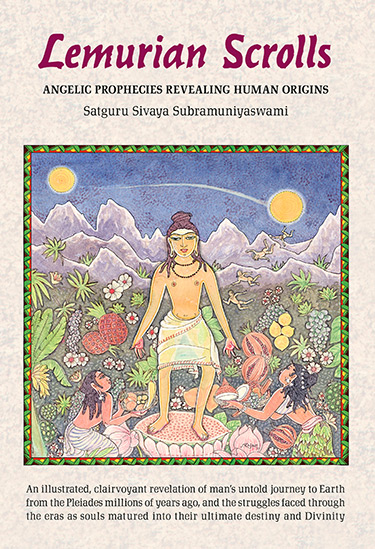
Lemurian Scrolls : Angelic Prophecies Revealing Human Origins By Satguru Sivaya Subramuniyaswami
Enliven your spiritual quest with a lavishly illustrated, clairvoyant revelation of man's untold journey to Earth from the Pleiades millions of years ago, and the struggles faced in ensuing eras as souls matured into their ultimate destiny and Divinity.
This unusual book by Satguru Sivaya Subramuniyaswami was actually read from the akasha in 1973 and spent 25 years entrusted only to his cloistered monastic order.
"The Lemurian Scrolls will enlighten all who read it and it will become a "Source" that will constantly be referred to by serious students, teachers, leaders and metaphysical and spiritual groups
(Patricia-Rochelle Diegel, Ph.D)."
This unusual book by Satguru Sivaya Subramuniyaswami was actually read from the akasha in 1973 and spent 25 years entrusted only to his cloistered monastic order.
"The Lemurian Scrolls will enlighten all who read it and it will become a "Source" that will constantly be referred to by serious students, teachers, leaders and metaphysical and spiritual groups
(Patricia-Rochelle Diegel, Ph.D)."
Yoga’s Forgotten Foundation, Twenty Timeless Keys to Your Divine Destiny By Satguru Sivaya Subramuniyaswami
In spiritual life, without a foundation of good character
and discipline, success in yoga will not be lasting. Sooner or
later, the earthquakes in our personal life, the times of great
stress and difficulty, will bring outbursts of anger or periods
of discouragement, causing our higher consciousness to
fall back to Earth.
A must-read for serious yoga practitioners, meditators and anyone deeply involved with transformative spiritual life, Yoga's Forgotten Foundation delves into the integrated approach to yoga as taught by the great masters of India. It is a cogent reminder to those who want to start at the end of the spiritual path that there is an essential beginning, the neglect of which portends failure and disappointment.
In 224 pages, with full-color Indian art, it explores the traditional foundation of yoga, twenty little-known guidelines on personal ethics, self-control and religious practice, called the yamas and niyamas. The yamas and niyamas have been preserved through the centuries as the first and second stage of the eight-staged practice of yoga. They provide the essential foundation to support our yoga practice so that attainments in higher consciousness can be sustained.
The book begins with a forward by the author's spiritual successor, Satguru Bodhinatha Veylanswami, and takes the reader step by step through noninjury, truthfulness, nonstealing, sexual purity, patience, contentment and other facets of virtue.
Grounded in a traditional Hindu point of view, yet admirably relevant to us all, the book discusses some of the toughest issues and challenges of modern life, including promiscuity, domestic abuse, child-rearing, overeating, gambling, vegetarianism, violence, injustice and pornography—relating them all to progress on the yoga path. It also explores the essential practices, including charity, worship, chanting mantras, austerity and scriptural study. 224 pages, full color.
A must-read for serious yoga practitioners, meditators and anyone deeply involved with transformative spiritual life, Yoga's Forgotten Foundation delves into the integrated approach to yoga as taught by the great masters of India. It is a cogent reminder to those who want to start at the end of the spiritual path that there is an essential beginning, the neglect of which portends failure and disappointment.
In 224 pages, with full-color Indian art, it explores the traditional foundation of yoga, twenty little-known guidelines on personal ethics, self-control and religious practice, called the yamas and niyamas. The yamas and niyamas have been preserved through the centuries as the first and second stage of the eight-staged practice of yoga. They provide the essential foundation to support our yoga practice so that attainments in higher consciousness can be sustained.
The book begins with a forward by the author's spiritual successor, Satguru Bodhinatha Veylanswami, and takes the reader step by step through noninjury, truthfulness, nonstealing, sexual purity, patience, contentment and other facets of virtue.
Grounded in a traditional Hindu point of view, yet admirably relevant to us all, the book discusses some of the toughest issues and challenges of modern life, including promiscuity, domestic abuse, child-rearing, overeating, gambling, vegetarianism, violence, injustice and pornography—relating them all to progress on the yoga path. It also explores the essential practices, including charity, worship, chanting mantras, austerity and scriptural study. 224 pages, full color.
Friday, March 28, 2014
Self & Samadhi By Satguru Sivaya Subramuniyaswami
Echoing the ultimate teachings of Hindu scripture, Gurudeva, Sivaya Subramuniyaswami, spoke boldly of the Divinity within us.
This book is a collection of those teachings, nine inspired talks in which he urges us to mold our thoughts, emotions and way of life around this knowledge.
He explains that the Self is the core of you, the part of you that is identical to God in His Parasiva perfection. One of his trenchant teachings was "God is the Life of your life, your very Self."
The study of awareness is a great study. “I am aware.” The key to this entire
study is the discovery of who or what is the “I am.” It is the key to the
totality of your progress on the path of enlightenment.
What is awareness?
As you open your physical eyes, what is it that is aware of what you see?
When you look within, deep within, and feel energy, you almost begin to
see energy. A little more perception comes, and you do actually see energy,
as clearly as you see chairs and tables with your physical eyes open.
This book is a collection of those teachings, nine inspired talks in which he urges us to mold our thoughts, emotions and way of life around this knowledge.
He explains that the Self is the core of you, the part of you that is identical to God in His Parasiva perfection. One of his trenchant teachings was "God is the Life of your life, your very Self."
The study of awareness is a great study. “I am aware.” The key to this entire
study is the discovery of who or what is the “I am.” It is the key to the
totality of your progress on the path of enlightenment.
What is awareness?
As you open your physical eyes, what is it that is aware of what you see?
When you look within, deep within, and feel energy, you almost begin to
see energy. A little more perception comes, and you do actually see energy,
as clearly as you see chairs and tables with your physical eyes open.
Sunday, March 2, 2014
Free Ebooks on Yoga
Yoga
Yoga is a family of ancient spiritual practices originating in India. It is one of the six schools of Hindu philosophy. In India and across the World, Yoga is seen as a means to both physical health and spiritual mastery. Outside India, Yoga has become primarily associated with the practice of asanas (postures) of Hatha Yoga.
Yoga as a means of spiritual attainment is central to Hinduism (including Vedanta schools), Buddhism, and Jainism, and has influenced other religious and spiritual practices throughout the world. Hindu texts establishing the basis for yoga include the Upanishads, the Bhagavad Gita, the Yoga Sutras of Patanjali, the Hatha Yoga Pradipika and many others.
The four main paths of Yoga are Karma Yoga, Jnana Yoga, Bhakti Yoga and Raja Yoga. A committed practitioner of yoga is referred to as a yogi, yogin (masculine), or yogini (feminine).
Free Ebooks on Yoga
What are Mudras?
Free Ebooks by William Lilly
William Lilly
William Lilly (May 11, 1602 - June 9, 1681), was a famed English astrologer and occultist during his time. Lilly was particularly adept at interpreting the astrological charts drawn up for horary questions, as this was his speciality.
He caused much controversy in 1666 for allegedly predicting the Great Fire of London some 14 years before it happened. For this reason many people believed that he may have had started the fire, but there is no evidence to support these claims.
Free Ebooks by William Lilly
William Lilly's History of His Life and Times
Free Ebooks on Theosophy
Theosophy
Theosophy, literally "wisdom of the divine" (in the Greek language), designates several bodies of ideas. Philosophers such as Emanuel Swedenborg and Jacob Boehme are commonly called theosophists. The word was revived in the nineteenth century by Helena Petrovna Blavatsky to designate her religious philosophy which holds that all religions are attempts by humanity to approach the absolute, and that each religion therefore has a portion of the truth. Together with Henry Steel Olcott, William Quan Judge, and others, Blavatsky founded the Theosophical Society in 1875. This society has since split into a number of organizations, some of which no longer use the term "theosophy".
A formal definition from the Concise Oxford Dictionary describes Theosophy as "any of various philosophies professing to achieve a knowledge of God by spiritual ecstasy, direct intuition, or special individual revelation; esp. a modern movement following Hindu and Buddhist teachings, and seeking universal brotherhood." Madame Blavatsky's theosophy would, however, not fall under this definition, as it is non-theistic.
Adherents of Theosophy maintain that it is a "body of truth" that forms the basis of all religions. Theosophy, they claim, represents a modern face of Sanatana Dharma, "the eternal truth," as the proper religion.
Free Ebooks on Theosophy
Occult Chemistry
Subscribe to:
Posts (Atom)